Your Two Brains: The Higher Mind vs. the Threat-Detector
A capable person sits down to do important work and simply cannot start. The brain research has a measurable account of why, and it is not about willpower.
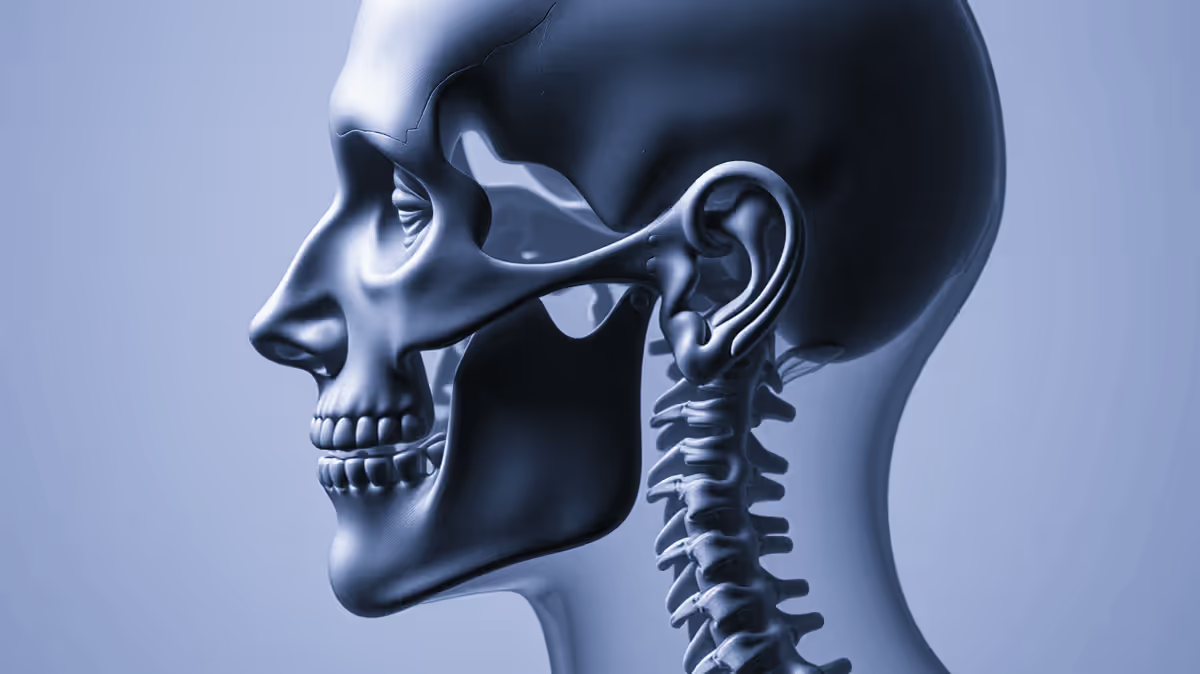
You clear your calendar for the one task that matters. You know exactly what to do. You have done harder things.
And you do not start.
You answer email instead. You reorganize a folder. You make coffee. The task sits there, fully understood, and your hand will not move toward it.
That is the part nobody explains well. It is not confusion. It is not laziness. The person who freezes is often the most competent person in the room.
For thirty years the productivity industry has told that person one story: you lack discipline. Try harder. Want it more. The story is sticky because it sounds like accountability. But it explains nothing about why a disciplined adult can run a company and still stall on a single overdue page.
The brain research points somewhere else. And what it points at is finally specific enough to measure.
Two systems, not one character flaw
Start with a piece of anatomy most people never get taught.
You do not have one decision-maker in your head. You have at least two, and they often disagree.
The first is the prefrontal cortex, the front of the brain, sometimes called the executive center. It handles planning, weighing both sides of a choice, deferring a reward now for a bigger one later, and governing your own behavior. It is slow, deliberate, and it is the part of you that makes a strategy and follows it.
The second is the amygdala, a small almond-shaped cluster of nuclei buried deeper and lower in the brain. Its job is older and simpler: detect threat, fast. It does not deliberate. It reacts.
One teacher of this material describes the split plainly. "You have in your brain a prefrontal cortex, which is the executive center, which is involved in self-governance, self-mastery, and objective reason. And you also have a subcortical area of the brain, a deeper nuclei called the amygdala. The amygdala is the desire center, and it is impulsive and instinctual and seeks and avoids pleasures and pains. And it is extrinsically driven because it's designed for emergencies."
Designed for emergencies. Hold onto that.
The amygdala evolved for a world where the wrong move got you eaten. Speed mattered more than accuracy. So it errs toward alarm. When it flags something as a threat, it fires before the slower executive center has finished thinking.
That timing is the whole problem.
What the imaging actually shows
Here is where the research gets concrete, because freezing on a task is not the same as fleeing a predator. So why would a threat-detector ever fire at a spreadsheet?
A 2022 study in Nature Communications, titled "A neuro-computational account of procrastination behavior," used fMRI to look at the brains of people deciding whether to start a task or put it off. fMRI tracks blood flow as a proxy for which regions are working.
Two findings matter for our question.
First, when people were more prone to delay, there was heightened activity in the amygdala, the threat-detector. The task was registering, at some level, as something to avoid.
Second, and this is the part the discipline story cannot touch: the delay was linked to a weaker connection between the task and its valued payoff. The brain was not failing to want the reward. It was failing to associate the unpleasant work in front of it with the outcome that reward represents.

Read that again, because it reframes everything. The freeze is not a deficit of wanting. It is a broken link between the boring task and the thing you actually care about. The threat-detector sees the immediate discomfort up close and loud, and the distant valued outcome stays faint and far away.
So the amygdala does what it was built to do. It treats the discomfort as a threat and pulls you toward escape, which is to say, toward the email, the folder, the coffee.
That is not a character defect. That is a small ancient circuit doing its assigned job a little too well.
The exaggeration is a feature
To see why the threat-detector overreacts, it helps to borrow a framing from the values-science tradition this research connects to, developed by Dr. John Demartini, whose work on human values sits underneath a lot of this teaching.
In that framing, the amygdala does not just notice threat. It distorts perception to mobilize you. Think of a prey animal. A rustle in the grass might be wind or might be a lion. The animal that treats every rustle as a lion survives more often than the one that calmly checks. So the threat-detector exaggerates on purpose. Exaggeration is how it gets a body moving before the thinking brain can object.
Map that onto your overdue task. The discomfort of starting gets amplified. The cost of not starting, which is real but distant, gets muted. You are not being irrational. You are running a survival circuit in a context it was never designed for.
In Demartini's framing, the thalamus plays a gatekeeping role here too, with a region called the pulvinar acting like a filter that biases what you even notice. You attend closely to what your deeper drives flag as urgent, and you stay strangely blind to what feels far away, even when you know it matters more. The filter is set by what registers as threat and what registers as reward, not by what is logically most important.
This is why the freeze is so disorienting from the inside. The part of you that knows what matters is not the part holding the steering wheel in that moment.
Which brain is driving
If two systems can run the show, the practical question becomes: which one is online right now, and can you change that?
The teacher quoted above puts the stakes bluntly. "The executive center in the forebrain is necessary for wealth building. The amygdala is not going to get you there. It's too emotional. It's going to be impulsive. You're gonna end up gambling and taking crazy risks and being subjectively biased and not really present."
Not really present. That phrase fits the Nature finding. When the threat-detector is in charge, your time horizon shrinks. The next ten minutes feel enormous and the next ten years feel theoretical. Impulsive choices win because the slow planner is offline.
The same teacher offers the instruction that follows from the model: "Be wise and be strategic and use your executive center, not your amygdala, and think long term and be patient." It is a simple line, and the model is what makes it more than a platitude. You are not being told to feel differently. You are being told which circuit to bring back online.
There is no peer-reviewed figure for exactly how often the executive center loses these standoffs, and anyone who quotes one to you is guessing. But the direction of the evidence is clear: the freeze is a contest between two systems, and the threat-detector is faster off the line.
Why this matters more than the willpower story
Two accounts of the same moment.
The discipline story says: you froze because you are weak, and the fix is to be stronger. It has no mechanism. It cannot tell you what is happening in the brain, which is why it has not helped much in thirty years.
The two-system account says: you froze because an ancient threat-detector fired before your executive center could weigh in, and because the link between the task and what you value had gone faint. It has a mechanism. It can be imaged. It points at a real lever, which is restoring that link between the work and the outcome you actually care about, so the valued payoff stops being faint and the executive center has something to pull toward.
The second story is not kinder for the sake of comfort. It is just more accurate. And accuracy is what finally makes the problem something you can work on instead of something you are.
You are not the person the discipline myth describes. You are a capable operator running a normal brain, one that is doing exactly what it evolved to do. The work now is not to want it more. It is to know which of your two brains is at the wheel, and to give the slower, wiser one a reason to take it back.
If you want to see which outcomes your own attention is actually weighted toward, the free Power Code values assessment at rise.inspirean.com is a reasonable diagnostic place to start.