The Threat-Detector and the Executive: A Clean Look at What the Amygdala and Prefrontal Cortex Actually Do
Two structures in your brain run on different logic. When you know which one is driving, the thing you've been calling a willpower problem starts to look like something else.
You sit down to do the one task that matters most this week. And you find yourself reorganizing your inbox instead.
Not because the task is hard. Because something in you treats it like a threat.
That reaction has a measurable source. Two of them, actually, and they don't agree with each other.
The threat-detector
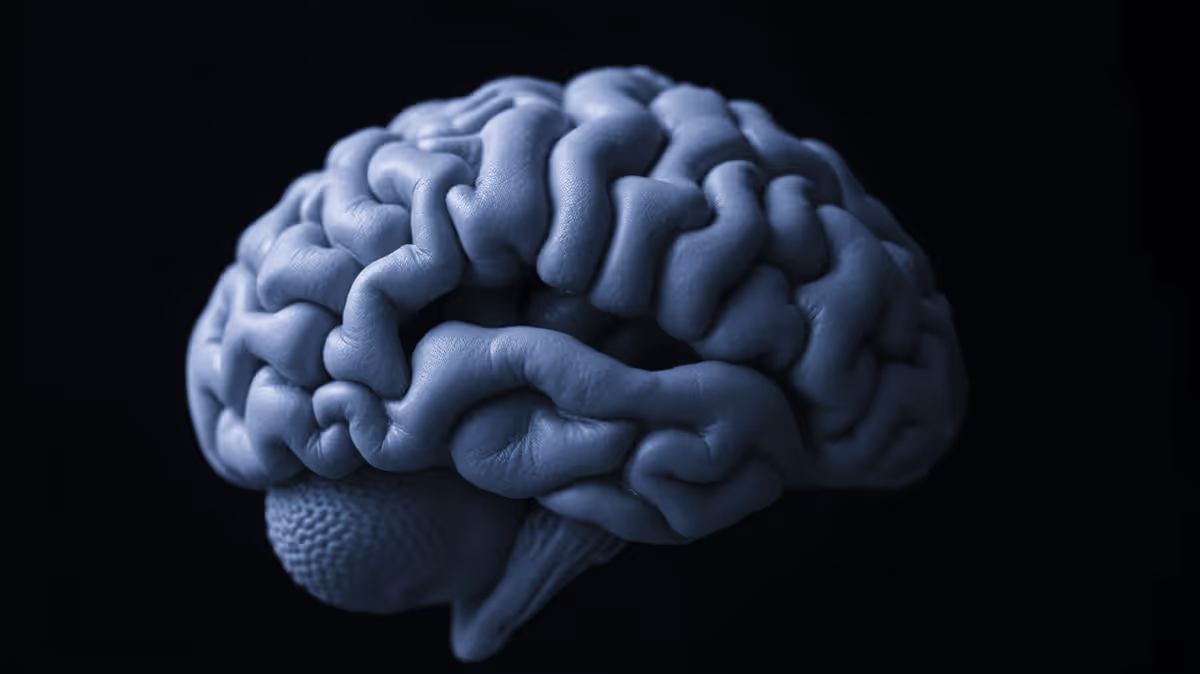
Deep in the brain, below the folds you can see, sits a small almond-shaped cluster called the amygdala. It is old, fast, and built for one job: keep you alive.
It runs on a single question. Is this safe, or is this a threat?
Picture an early human hearing a rustle in the bushes. The amygdala doesn't wait for proof. It assumes predator and floods the body with adrenaline, because the cost of being wrong about a real predator is death, and the cost of being wrong about the wind is a wasted sprint.
So it errs toward false alarms. By design.
That bias hasn't gone anywhere. The amygdala still scans for threats, it still jumps to the worst case, and it still can't tell the difference between a lion and a spreadsheet that feels dangerous to your sense of who you are.
The executive
Behind your forehead sits the prefrontal cortex. It is the newer structure, and it runs on slower, more deliberate logic.
It governs. It plans. It weighs both sides of a decision and sits with discomfort long enough to do something useful with it.
The distinction is worth stating plainly. The prefrontal cortex is the executive center: self-governance, self-mastery, the capacity for objective reason. The amygdala, a deeper cluster of nuclei, is the opposite kind of machine. It is impulsive and instinctual, it seeks reward and avoids pain, and it is driven by what is outside you in the moment, because it was designed for emergencies.
That last word matters. Emergencies.
The amygdala is an emergency system running in a world that, for most of us, is no longer a string of emergencies. The threats it flags are rarely physical anymore. They're social, financial, and tied to identity. And the system responds the same way it always has.
What the brain imaging actually shows
Here is where the research gets specific, and where it's worth being careful about what is genuinely known.
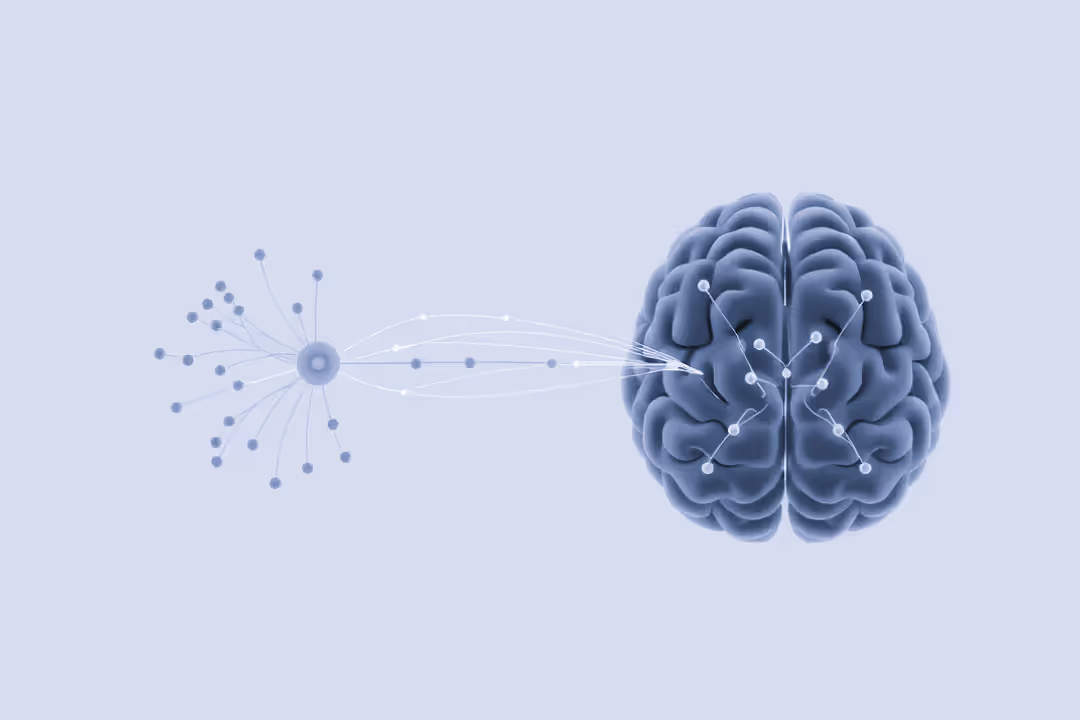
In 2022, a team published a study in Nature Communications titled "A neuro-computational account of procrastination behavior." They put people in an fMRI scanner and watched what happened in the brain when those people chose to delay a task.
The finding was not that lazy people have lazy brains. It was mechanical.
Procrastination tracked with amygdala activity, and with a specific failure: the brain wasn't successfully linking the task in front of it to a valued outcome down the line. When that link is weak, the threat-detector wins. The task reads as cost now with no clear reward attached, and the system that's wired to avoid cost does what it's wired to do.
That is one study, on a mechanism. It does not prove any program, course, or assessment fixes anything. It does something narrower and more useful. It gives the everyday experience of stalling out a physical location and a logic.
You're not failing to start. Your threat-detector is correctly protecting you from something it has flagged as a cost with no payoff in sight.
Why willpower keeps losing
This reframes a question most people get backwards.
The standard story says procrastination is a discipline problem. Push harder, white-knuckle it, and you'll win. And for a lot of capable, accomplished people, that story has never quite added up. They have discipline. They've proven it a hundred times in the areas they care about.
So why does it collapse on this one task?
Because you can't out-discipline a threat response. The amygdala isn't asking whether you're trying hard. It's asking whether this thing is safe. Willpower is a prefrontal tool, and the prefrontal cortex is the slower system. In a contest of speed, the emergency wiring fires first.
This is the part the productivity industry has spent thirty years getting wrong. It sells discipline as the missing ingredient, when the evidence points somewhere else: to a mismatch the brain is reacting to, not a character flaw the brain is exposing.
The values question hiding underneath
So if it isn't discipline, what determines whether the threat-detector fires?
The most developed answer comes from the work of Dr. John Demartini, whose values science, the framework behind the Values Determination Process, has spent decades on a single observation. People reliably follow through on what is genuinely high in their own hierarchy of values, and reliably stall on what is low in it, no matter how much they think they "should" want it.
Read that against the brain. A task that's low on your real value hierarchy is, to the amygdala, a drain. Resources spent here are resources pulled from what you actually care about. So the threat-detector flags it. Not as laziness. As a correct reading that this particular goal is competing with what matters more to you.
A task that's high in your values reads differently. The executive center comes online. You become willing to sit with the boring parts, the hard parts, the parts with no immediate reward, because the payoff is real to you and the brain can see it.
The follow-through you already have in some areas of your life isn't luck. It's alignment. The question worth asking is what's different about those areas.
Why this is a relief, not an excuse
None of this lets anyone off the hook. The point isn't that you can't act. It's that the lever is in a different place than you were told.
If stalling were a discipline defect, the fix would be more pressure, which is exactly the thing that's been failing. If it's a values mismatch the brain is flagging, the fix is to look honestly at what you actually value, and either move the task closer to it or stop pretending the task was ever going to get done by force.
As one framing of this puts it: "use your executive center, not your amygdala." Bring the thing into order and priority. Let the slower, governing system weigh both sides instead of letting the alarm run the day.
The brain isn't broken when it stalls. It's doing precisely what it evolved to do. The work is to give the executive center a clearer view, so the threat-detector has less to shout about.
That's a more honest picture than "you lack discipline." It also happens to be the one the imaging supports.
If you want to see what your own value hierarchy actually looks like, rather than what you assume it is, the free Power Code values assessment at rise.inspirean.com is one diagnostic place to start.